
Owners · 6 min
Who Pays, Who Receives, and When? How to Keep Property Expenses Traceable
Trace a property expense from the initial issue through supporting documents and invoicing to verified payment.

An invoice or receipt for a repair arrives, you log the amount, and you save the file. On the surface, the expense has been recorded. A few weeks later, however, fresh questions arise: which job did it relate to, who settled it, has it already been included in a statement, and does anything further need to be done? A standalone figure is rarely enough to answer these questions.
Transparent expense tracking preserves the entire journey of an event. It links the property, the initial requirement, the associated document, the agreed payment direction, and the settlement status. This is particularly crucial when the property owner, tenant, and property manager are all involved. Each of them is looking for answers to different questions while discussing the exact same item.
The First Question: What Actually Happened?
Every cost should stem from an identifiable event or service. The label "repair" offers little guidance later on. "Replacing the kitchen tap washer following the June fault report" provides meaningful context immediately. You do not need a lengthy story, just the few key details that allow a colleague or accountant to recognise the matter straight away.
Record the property, the date or period concerned, the category, and the available document. If a maintenance ticket preceded the job, keep that connection intact. If it is a recurring item, make it clear which period it covers. Consistent naming also helps considerably when searching and comparing records later.
Enter the details while the origin of the expense is still fresh in mind. At month-end, it is far harder to recall why a specific replacement part was needed or which flat the tradesperson visited. Early recording does not require every detail to be final, but any missing information should be clearly flagged.
Distinguish Between the Quote and the Actual Cost
The estimated cost of planned work is entirely different from the final figure for completed work. A quote supports decision-making; the actual cost forms part of tracking the financial reality of an event. If you mix the two up, your records may present figures as established facts when they are still subject to change.
It is well worth recording which quote informed the decision and what was subsequently carried out. If the final amount differs, the reason for the variance should be readily understandable. For example, further work was required on site, or an alternative solution was chosen. Such explanations are far more useful during future discussions with an owner than merely placing two contrasting figures side by side.
The RentalSys Knowledge Base covers logging costs and quotes in detail. When establishing your workflow, decide from the outset what stage of information you are logging. Treat data as finalised only when the necessary documentation and confirmations are available.
Clarify Payment Liability First
The fact that an expense arose in a particular flat does not automatically dictate who bears it. The payment direction must be clarified based on the tenancy agreement and the specific circumstances. Your records make this decision traceable. Do not automatically infer the payer from the label of the expense or a previous similar case.
Always answer three questions separately: who is paying, who is the recipient, and into which bank account is it being settled? In multi-party management, the same property can feature across several financial relationships. It is therefore essential that an item includes not just the amount, but also the correct parties.
If liability is still under discussion, keep that open status visible. There is no benefit in passing an unresolved matter along simply to shorten a task list. Note what decision is pending, who is expected to provide it, and when it will be reviewed. That way, the issue moves forward while the records preserve the genuine reason for the delay.
Decide How It Enters the Settlement
Once an expense is logged, allocating it to a payment request can be a separate step. The RentalSys guide highlights three options: assigning it to a recurring payment request rule, adding it to an existing payment request, or creating a new payment request. These address different scenarios, so your choice should align with your actual billing schedule.
If an item is to be settled in the next regular cycle, assigning it to a rule may be the right approach. If the relevant payment request already exists, check its details and status. For ad-hoc settlement, a new payment request can be generated with the appropriate date, due date, and parties. In every case, review the final contents before marking the task complete.
To prevent duplication, ensure you can trace which settlement the expense was assigned to. If someone reopens the case later, they should not have to search through the entire list of payment requests. It is equally important to spot if an expense has been logged without any settlement assignment at all.
Three Illustrative Examples Following the Same Logic
In the first example, we have an agreed, recurring service charge. The item description specifies the period covered, the payment direction is clear, and the entry is assigned to the corresponding recurring billing cycle. The monthly check verifies whether the amount and frequency remain up to date. Here, routine simply means periodic review of the data.
In the second example, a consumption-related utility cost arises. The records must retain which meter, which reading period, and which baseline data the figure relates to. Should the tenant have questions, this data trail provides the answers. Instead of a generic "utilities" line, an identifiable period gives the charge clear context.
In the third example, a one-off repair takes place. The maintenance ticket, job description, post-completion documentation, and final cost all belong together. The responsible payer is agreed for that specific case, and the item is allocated to the appropriate settlement. When reviewing records later, the full event behind the financial figure remains visible. These are illustrative workflows, not universal rules on who must bear a given cost.
Payment Is a Distinct Checkpoint
Once a payment request has been generated or issued, the process is not necessarily complete. The actual receipt of payment must be identified and recorded. Check the amount, the date, and the associated item. Any discrepancy should trigger its own reconciliation task. An expense is only fully traceable when its settlement status is verified.
This distinction is also vital when reporting to property owners. There is a clear difference between an amount having been incurred, billed, or already received. Using the same terminology for all three stages will lead to misleading reports. Use consistent status labels, accompanied by a brief note on the next step where necessary.
Who Checks the Entire Journey of an Item?
With multiple parties involved, different people may handle the same expense. An on-site contractor or inspector knows what happened, an administrator handles the paperwork, and a finance team member oversees settlement. It is wise to designate someone to verify that these threads have actually been connected. Without this, each sub-task may appear complete while the overall picture remains fragmented.
During routine checks, select a handful of items and trace them backwards from the expense to the original event, and forwards to the final settlement. If any link is missing, correct the data and the logging habit. This spot-checking approach highlights where information regularly gets lost in handovers. The objective is not to create another parallel spreadsheet, but to ensure existing records clearly connect the entire process—so you never have to reconstruct matters from memory when questions arise months later.
A Practical Expense Checklist
For every item, your checklist should include the property, a brief description, the relevant period, the document reference, the payment direction, the settlement link, and the payment status. If any of these are missing, that in itself defines the next task. The aim is not to collect as many spreadsheet columns as possible, but to find answers to every essential question in a single place.
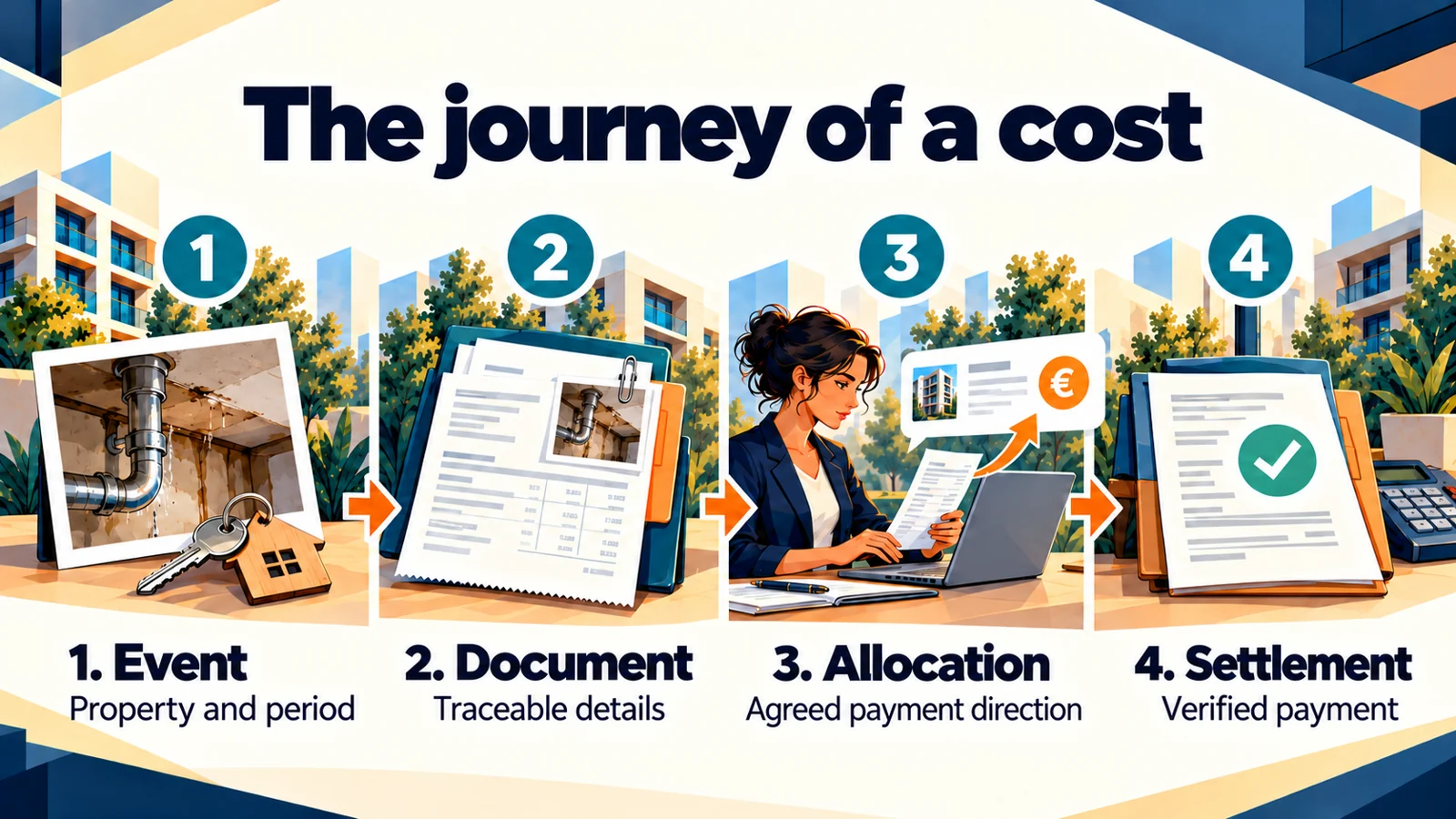
Try this sequence with your next expense. First identify the event, then the document, followed by the agreed payment direction and billing method. Finally, verify the payment itself. If this chain remains unbroken, you will always know exactly what happened with any given amount, even months down the line.
Related how-to guides
Related articles
Ask about this article
Still have a question? Send it to us and we will receive it together with the article reference.
Start using RentalSys for free
Put the article into practice with your own property.
- No credit card required
- Free tier included
- 3-minute setup