
Managers · 6 min
Going on Holiday? How to Hand Over Property Management to a Colleague
Seamless property management handover for holidays: tracking open issues, next steps, responsibilities, deadlines, and the return process.

Your cover colleague logs into the system, sees the properties, and locates tenant details. Yet they get stuck on an open maintenance ticket: they do not know whether a contractor has been contacted, whether approval is pending, or when a response was promised to the tenant. The access is there, but the context needed to continue the work is missing. This distinction determines whether a handover actually works in practice.
A well-prepared cover arrangement ensures your colleague understands what has happened so far, what comes next, and the decision-making framework within which they can operate. Preparing for a ten-day absence follows the exact same principles as handing over tasks permanently. The goal is to keep daily operations smooth and trackable without constantly calling the absent team member.
Take Inventory of Active Issues
Begin the handover by compiling all open tasks. Review properties, ongoing maintenance tickets, upcoming events, financial items requiring clarification, and pending documents. The list should highlight matters where action might occur during your absence, or those tied to specific deadlines. Instead of recounting the entire history, focus on continuity.
Write a brief, factual status update for each issue. For instance: “Contractor received photos; awaiting proposed dates” or “Awaiting tenant confirmation to identify payment”. Clear phrasing like this indicates exactly where the process stands. “In progress” or “under discussion” on its own does not provide enough context for someone stepping in.
During this stocktake, it often turns out that an issue can already be closed because the records simply were not updated. Settle these before the handover. That way, your cover does not waste time reviewing tasks that are already complete, and remaining open issues receive greater focus.
Assign a Clear Next Step to Every Item
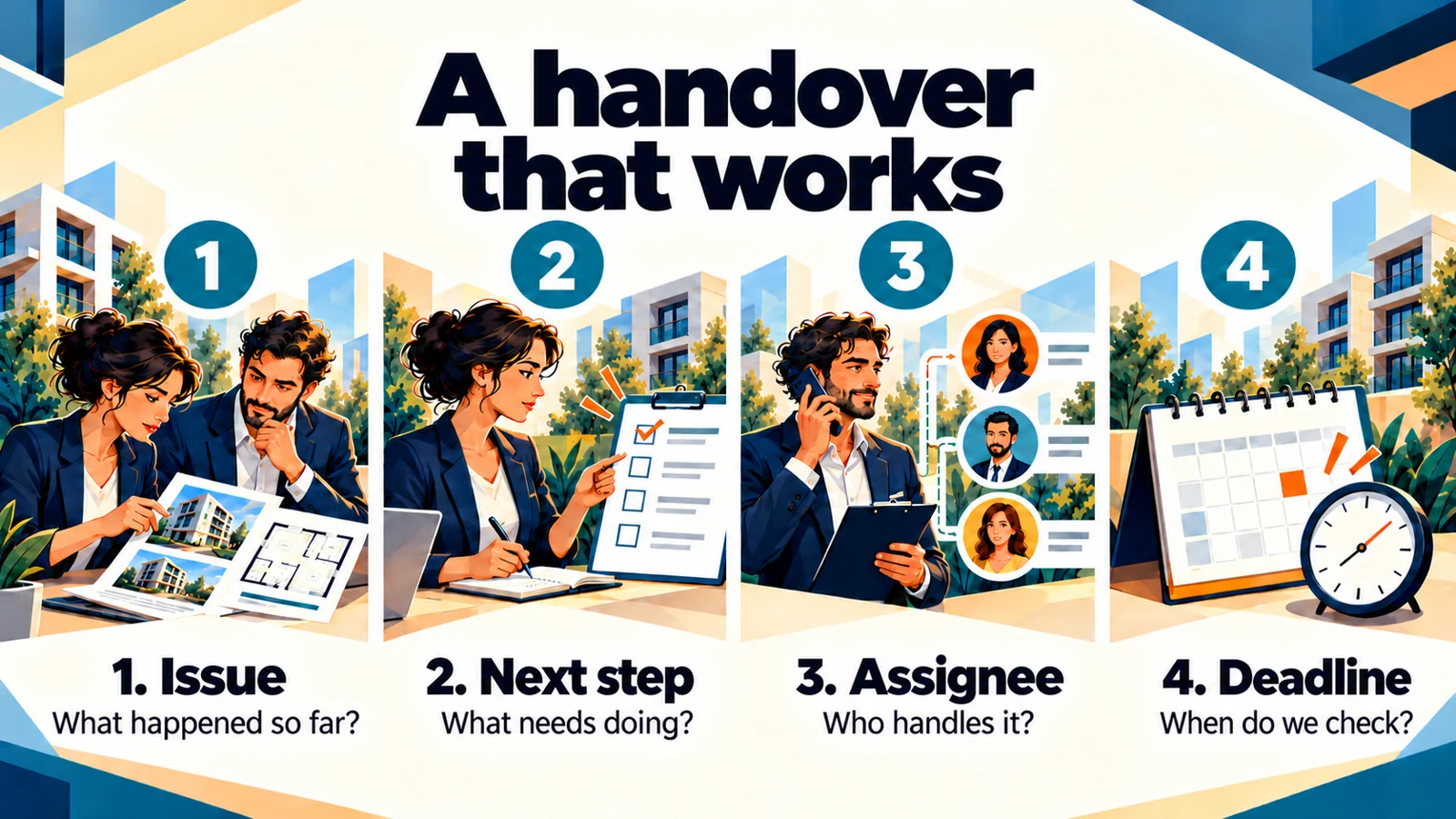
An effective handover item clearly names the property, the issue, the current status, the next action, the responsible person, and the deadline. The next step should be an actionable task: arranging an appointment by phone, requesting a document, verifying a payment, or logging feedback from a site visit. If the required action is not yet clear, clarify it before handing it over.
Distinguish between the final deadline and the date for the next follow-up. A job might not have a confirmed completion date yet, but it may be essential to chase the contractor for an appointment on Friday. The latter is a scheduled, actionable task. This enables your colleague to take proactive steps even when waiting on an external party's response.
Example handover item: “Garden Street flat – oven fault – photos sent to contractor – chase for appointment slot – cover manager – check on Wednesday morning”. The complete issue history should be linked to this, but the single line must communicate the immediate action required. A concise summary alongside detailed documentation makes a handover truly practical.
Check Necessary Access and Information
Your cover needs to be able to find all data required for their assigned tasks. This may include contact details, relevant documents, fault descriptions, previous correspondence, and calendar events. Manage organizational permissions according to your usual access policies. During handover, verify that the information essential for actual day-to-day work is readily accessible.
The test is simple: pick an open issue and ask your colleague to outline the next step solely from the recorded data. If they need additional verbal explanation, add that missing information to the system records. This immediately reveals what details remain in your head that are not yet visible to others.
The RentalSys Knowledge Base explains how to connect team members to an organisation and manage document categories. These are crucial components of collaborative working. However, during the handover process, you must verify data organisation and role assignments alongside basic system access. Technical access is only useful if it leads to coherent, understandable content.
Clarify Decision-Making Boundaries
Before your leave begins, discuss which matters your colleague can handle independently and when they need to involve someone else. Whom should they contact if unexpected costs arise? Who liaises with the landlord or owner? When is a management-level decision required? Concrete thresholds stem from your organisation's policies and must be clearly understood by everyone involved.
Communication protocols are particularly important if you will have limited availability. Establish a designated point of contact for urgent matters that cannot wait until your return. At the same time, agree on which non-urgent tasks can be deferred. Ambiguous decision-making leads to far more interruptions than a few clear, predefined rules.
Avoid vague, catch-all instructions where specific circumstances dictate the outcome. It is far better to talk through a few typical scenarios and outline the criteria needed for a decision. This equips your colleague not just with an answer, but with a reliable decision-making framework.
Make Communication Easy to Hand Over
Notify affected tenants and partners about the cover arrangement if it directly affects how they get in touch. The notice should specify the period, relevant contact details, and who to approach for specific issues. Focus on actionable information rather than unnecessary details. The aim is to prevent them from expecting replies on a channel that someone else is now monitoring.
Ensure previous communications are easily traceable. The RentalSys outgoing email log helps you review which automated or system messages were sent, when, and with what content. Key details discussed over the phone must be logged separately. For the colleague covering, the current status of the matter is what matters, regardless of communication channel.
A brief notice could read, for example: “During the specified dates, my colleague will be overseeing ongoing matters regarding the property. You will find their contact details attached. I have briefed them on your previously reported issue; the next agreed step is confirming an appointment date.” Always tailor specifics to the situation at hand.
Use Shared Calendar Anchors
Meetings, inspections, and follow-up calls due during your absence should have clearly defined dates and times. The calendar entry should identify both the property and the issue. If the event depends on an external party, indicate whether the timing is confirmed or still provisional. This prevents an unconfirmed slot from being treated as a firm appointment.
The RentalSys calendar guide covers property-linked events, recurring tasks, and reminders. Use the features that best support your internal workflow during the handover period. However, a calendar is only a dependable guide if updates are logged diligently. An outdated entry for a rescheduled meeting causes just as much confusion as a missing entry altogether.
Test the Handover Before You Leave
On your final working day together, select three different types of cases: a deadline-driven event, a task awaiting an external response, and a financial query needing clarification. Ask your cover colleague to explain what they would do next based solely on the recorded information. This quickly shows whether the documentation is precise enough and whether decision boundaries are genuinely clear.
If your colleague suggests a different course of action, discuss the reasoning. Perhaps an earlier commitment or document is missing, or the case status is out of date. Feed any insights from this test back into the handover list. This avoids having to resolve the very same questions over the phone on their first day alone. A brief dry run provides reassurance all round: you know tasks can proceed smoothly, and your cover can verify their readiness on real cases.
Ensure a Proper Handback Upon Return
At the end of the cover period, review which matters were concluded, what has changed, and what remains open. Your colleague should hand tasks back using the same structure in which they received them. This makes it straightforward to compare the initial and current statuses. Ensure full documentation and clear next steps remain in place for any new events that arose.
Finally, note any information that was missing or unclear during your absence. Incorporate these learnings into your everyday logging habits. If the same query arises repeatedly, it is worth turning it into a permanent field or regular checklist item. Preparing for your next absence will require far less effort because issues will already be maintained in a handover-ready state.

Related how-to guides
Related articles
Ask about this article
Still have a question? Send it to us and we will receive it together with the article reference.
Start using RentalSys for free
Put the article into practice with your own property.
- No credit card required
- Free tier included
- 3-minute setup