
Managers · 6 min
Seven Data Quality Errors That Repeatedly Create Extra Work in Lettings
Seven common data quality mistakes in property management, with actionable prevention steps and a routine audit process to keep records clean.

A payment request goes to the wrong address, a meter reading is difficult to verify, or a repair invoice cannot be found even after an extensive search. At first glance, these seem like entirely separate problems, yet they often share the same root cause: incomplete, inaccurate, or disconnected data. Such discrepancies trigger unnecessary follow-up messages, manual checks, and corrections during daily operations.
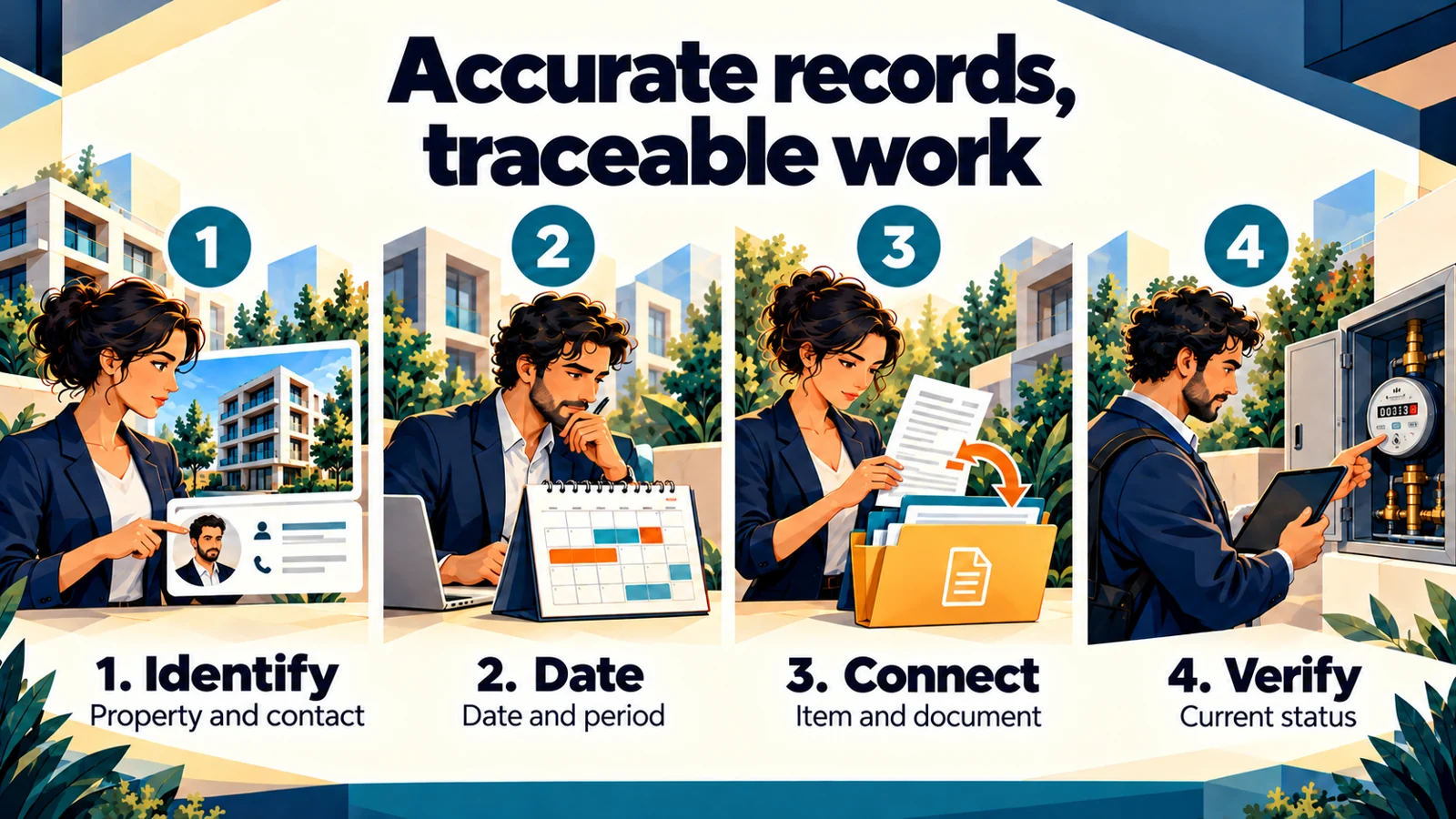
Data quality in lettings is a thoroughly practical matter. It simply means that anyone looking at the recorded information can readily identify which property, stakeholder, period, and event it relates to. When these relationships are unambiguous, the next colleague can pick up the case without friction. For the seven error types below, it is therefore well worth establishing verification checks that seamlessly fit into your day-to-day routine.
1. Outdated or Uncertain Contact Details
A tenant may have multiple email addresses or phone numbers, and over time, the person responsible for communications can change. If old details linger in the system, critical notifications might never reach the intended recipient. The property manager assumes the message was delivered, while the other party continues waiting for updates. This scenario quickly leads to redundant exchanges and avoidable misunderstandings.
Prevention relies on a straightforward checkpoint: verify the active contact details and designated notification recipient whenever a new tenancy agreement is drafted or a contact changes. The RentalSys tenancy guide demonstrates how to assign contact roles clearly. The priority is ensuring that the person recorded in the system is the one actively responsible for the day-to-day tenancy relationship.
Should delivery or communication issues arise, inspect the recipient details first. Checking sent correspondence in the outgoing message log provides a helpful baseline, but the core record must be updated as soon as a discrepancy is identified. A one-off correction only turns into a lasting solution if subsequent messages pull from verified data.
2. Inaccurate Tenancy Dates or Deadlines
Dates dictate a wide array of downstream tasks. The commencement date, tenancy expiry, rent demand issue date, and payment due date all serve distinct administrative purposes. If values carried over from an earlier draft or another property remain untouched, day-to-day administration will run on the wrong schedule. The error often only surfaces once further reconciliation or dispute resolution is already required.
When entering data, cross-reference the details against the final tenancy documents. Do not merely confirm that every field is filled in; verify that the dates are mutually consistent. When taking over an existing tenancy, pay particular attention to distinguishing between the original lease start date and the operational start date within your management system.
Establish a designated update step whenever changes occur. Verbal agreements or freshly signed documents do not automatically ensure operational data has been amended. Your checklist should therefore include a systematic comparison between the signed document and the software record. This brief check prevents numerous subsequent adjustments.
3. Unverified Payment Details
Errors involving bank accounts, payers, or payees directly complicate financial reconciliation. In multi-party management setups, it is crucial that transactions reflect the correct direction of payment. Identifying the property alone does not specify who is paying whom. Consequently, the parties attached to an expense or payment request must be verified individually.
When configuring new settings or applying amendments, review the entire data relationship. The description, period, amount, and payment details together form a coherent, interpretable transaction. A single correct field cannot compensate for an error elsewhere. Reviewing the final document preview often reveals mismatches that are easily overlooked during data entry.
If an issue is detected, record the rectified state alongside the required next step. Be sure to examine how the correction impacts the wider workflow. This ensures you do not leave updated master records running alongside legacy, conflicting entries without anyone noticing the gap.
4. Missing Initial Meter Readings or Incorrect Meter Identification
Subsequent meter readings can only be interpreted properly if the baseline figure and the meter's exact identity are known. If the initial reading is missing, the recorded date is inaccurate, or the uploaded photo shows a different meter, the entire data series becomes unreliable. During tenant handovers, this causes significant disruption, as two distinct billing periods must be clearly demarcated.
On-site, always check the serial number, the recorded reading, and the date. Ensure photographs are legible and clearly show the meter identifier where necessary. Once entered, review the figures within the platform interface. This final sanity check catches typographical errors or selecting the wrong meter from a dropdown list.
When an unusual variance appears, inspect the baseline data before jumping to conclusions. Once the underlying records are verified, you can investigate consumption patterns meaningfully. Drawing conclusions from an incorrectly entered number generates needless worry and administrative work. Precise identification remains the prerequisite for all subsequent analysis.
5. Expenses Lacking Periods or Linked Events
Labeling an expenditure as "other" or "repair" might make sense in the moment, but several months down the line, no one is likely to remember the exact context. Without an associated accounting period, property, and supporting document, the audit trail vanishes. Landlord reporting and tenant reconciliations then turn into time-consuming investigative tasks.
Use concise, specific descriptions and link every entry to its relevant event. Connecting the maintenance ticket, job description, and supporting invoice provides full clarity. For recurring expenses, make sure the relevant service period is instantly identifiable. Before saving, ask yourself: would another team member understand exactly what happened based solely on this entry?
Track the settlement status as well. Logging an expense and attaching it to a payment request are distinct operational steps. When this relationship is transparent, the risk of omissions or duplicate billing drops significantly. Maintaining a clear end-to-end trail also streamlines future audits.
6. Unidentifiable Documents or Ambiguous Versions
Labels such as "scan", "new", or "final2" offer little help when navigating dozens of similar files. A similar ambiguity occurs when it is unclear which document represents the current version and which is a superseded draft. The true value of digital storage lies in searchable naming conventions and structured document links.
Establish a straightforward file-naming convention: document type, property reference, date, and version marker where appropriate. Apply document categories consistently. Ensure the status of archived versus active documents remains obvious, aligning version control with your internal document management standards.
Check document visibility permissions relative to the task at hand. The RentalSys Knowledge Base details visibility settings linked to document categories. A well-named file is only genuinely useful in collaborative workflows if the relevant party can locate it immediately and understand its purpose without hesitation.
7. Overlooked Payment Confirmations or Stale Case Statuses
Funds have cleared into the account, but the invoice remains marked as open; a contractor has completed a repair, but the maintenance ticket still flags pending action. Such discrepancies trigger redundant status checks and unnecessary follow-up messages. A management system remains reliable only when operational statuses are updated promptly to mirror real-world events.
Assign clear responsibility for reconciling payments and closing out tasks. Reserve dedicated time within daily or weekly routines for status reviews. If a matter is only partially resolved, record the exact progress: for instance, noting that work is complete on-site but the contractor invoice is still pending. This ensures the next required action remains obvious to everyone.
Address the Root Cause After Fixing the Error
When the same operational mistake recurs, evaluate the conditions under which data was entered. Perhaps it was unclear which source document to rely upon, team members relied on personal abbreviations, or nobody was formally tasked with managing updates. In such circumstances, correcting the bad data must be paired with refining the underlying process. A concise standard operating procedure or shared reference example can resolve recurring ambiguities.
A valuable question to ask is whether the person entering the data understands how the wider team uses it later. When team members realise that entering precise dates enables accurate period apportionment, or that structured file naming supports seamless holiday cover, they naturally pay closer attention to critical details. Data quality then becomes a shared operational standard. In regular team reviews, highlight concrete examples where disciplined record-keeping facilitated smooth handovers, as well as instances where missing links caused friction. This provides a far more practical learning foundation than generic reminders to simply be more careful.
A Quick Data Audit You Can Repeat Regularly
Select a single property and review it across the seven key areas: contact details, dates, payment settings, meters, expenses, documents, and task statuses. Assign an owner and a concrete next step to any discrepancy found. Use the resolved issues to refine your data-entry guidelines or add practical checkpoints, ensuring the same oversight does not happen again.
Improving data quality is an ongoing discipline built on incremental habits. With the very next record you enter, focus deliberately on precise identification, date periods, and proper links. When the entire team embraces this standard, your property management records will answer operational queries automatically, drastically reducing the need to reconstruct historical details after the fact.
Related how-to guides
Related articles
Ask about this article
Still have a question? Send it to us and we will receive it together with the article reference.
Start using RentalSys for free
Put the article into practice with your own property.
- No credit card required
- Free tier included
- 3-minute setup