
Owners · 6 min
Transparent Tenant Changeovers: From Move-Out to Move-In
Manage seamless tenant changeovers with two checklists: condition reports, meter readings, maintenance, paperwork, and preparing the new tenancy.

The outgoing tenant moves out on Friday, and the new tenant is due to arrive on Monday. Between these two dates, cleaning, an inspection, and a few repairs will certainly be required. Behind the scenes, however, further tasks await: taking meter readings, sorting out documentation, reviewing open issues, and preparing the data for the new tenancy period. If these only exist in your head, it is easy to lose track of which event belongs to whom and to which period.
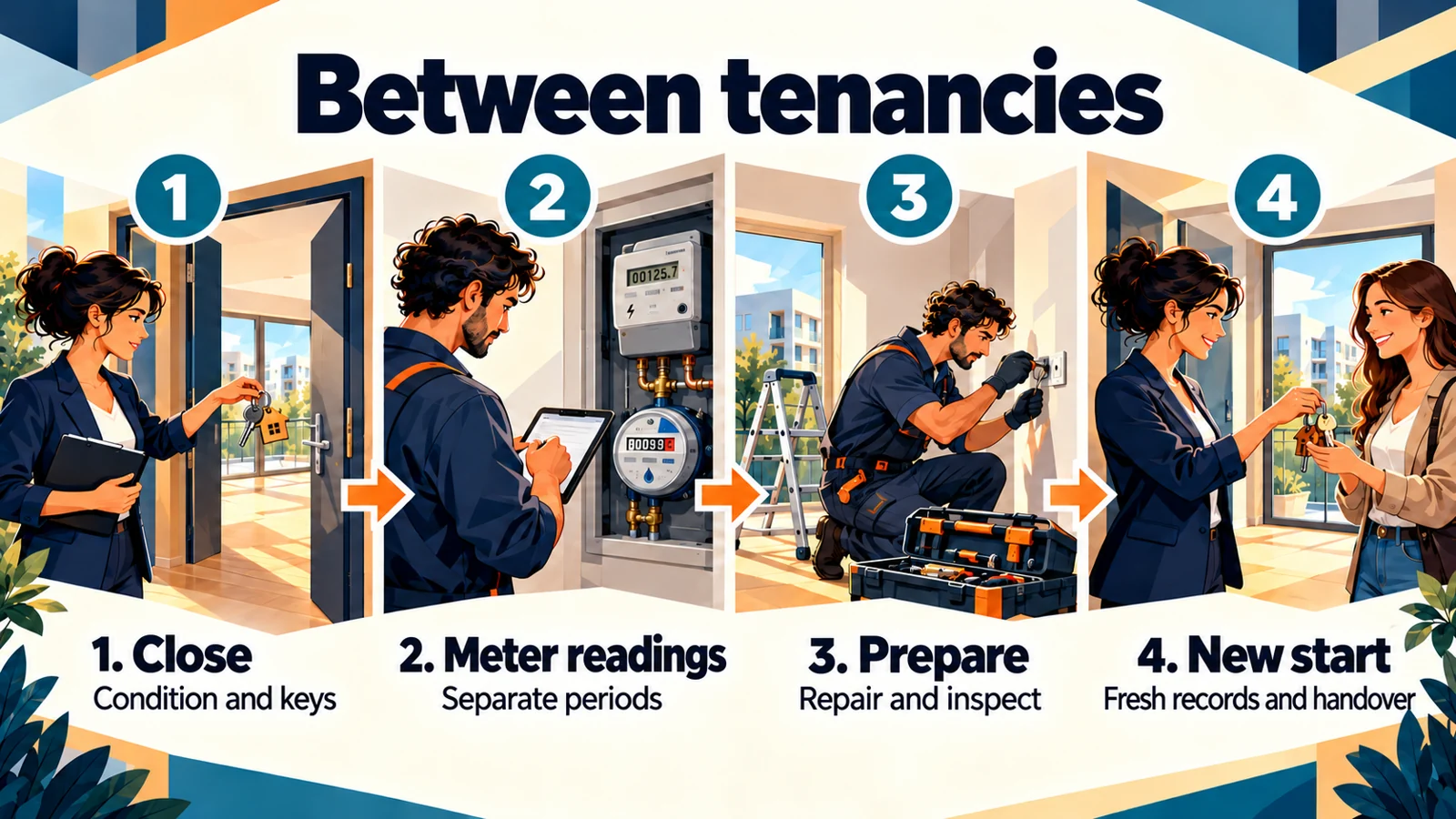
A tenant changeover consists of two interconnected processes. One brings the previous tenancy to a close, whilst the other creates a workable starting point for the new one. Both require their own checklist. The workflow below supports organisation and documentation; settlement decisions must always be guided by the specific agreements and circumstances of each case.
Start Preparations Before Move-Out
As soon as the changeover date is known, gather all open matters relating to the property. Are there repairs underway? Are any meter readings missing? Are there payments left to clarify? Will you need an outside tradesperson or specialist cleaning? The purpose of preparation is to ensure you have an actionable checklist ready by moving-out day, rather than scrambling for information on the doorstep.
Agree on the handover time and establish exactly what will take place during that meeting. Have the previous condition report, the inventory of furnishings, and the key log close to hand. If specific documents or details are still missing, request them in advance. This allows the tenant to prepare and enables you to plan your time more realistically.
Align the new move-in date with the tasks that genuinely need completing. Even a seemingly simple repair might reveal that spare parts or further coordination are required. The amount of buffer time varies from property to property, but without a task list, you cannot make an informed assessment.
Record the Property's Condition in a Consistent Order
Follow a consistent route during the check-out inspection. Walk through room by room and assess the same criteria everywhere: surfaces, appliances and fixtures, functionality, fittings, and cleanliness. This reduces the risk of overlooking the rest of the property due to a single conspicuous issue. Ensure the list has room for notes and items requiring further investigation.
When taking photographs, ensure the location remains identifiable later. A close-up of a damaged handle on its own may be insufficient; a wider shot shows which piece of furniture it belongs to. Store images organised by property and handover date. Include the room and item in the filename or accompanying description, rather than relying solely on the phone's default filename.
Recording the condition and determining liability are distinct steps. First, document what is actually observable. If an issue requires further clarification, mark it as open. An assumption made in the rush on site can easily lead to disputes later on. An accurate description provides a better starting point for both parties.
Let Meter Readings Separate the Two Tenancies
During a changeover, date-stamped meter readings are vital. Check that the serial number and the reading correspond to the correct property and meter. Take a legible photograph, and double-check the figures once recorded. A typo is easy to correct at this stage, but can require lengthy discussions later.
If cleaning, redecoration, or maintenance takes place between tenancies, utility consumption will still occur. Therefore, the outgoing tenant's closing reading and the incoming tenant's starting reading will not necessarily match. Record the actual readings and keep the void period separate. Manage costs according to the previously agreed allocation of responsibilities.
RentalSys's photo-verified meter reading feature provides a reliable record to refer back to later. However, the value of this feature depends on selecting the right meter, entering the correct date, and taking a legible photograph. Digitalisation builds on thorough on-site verification.
Do Not Carry Over Open Issues Unattributed
At move-out, there may be issues that cannot be resolved immediately. This could include a missing document, a cost awaiting clarification, or work scheduled for a later date. Keep a separate list for these. Each item should specify the relevant period, the required information, the person responsible, and the next review date.
In your records, clearly distinguish between tasks relating to the former tenancy and actions concerning ongoing property operations. For example, a repair might be a prerequisite for the new tenant moving in, even while the associated cost allocation remains under discussion. Progress in one process does not automatically resolve the other.
Check the keys and devices handed back against your inventory. Rather than merely noting quantities, write down identifiable descriptions: front door key, letterbox key, gate fob, remote control. This way, when preparing the handover pack for the new tenant, you can see precisely what is available and what still needs replacing.
Create a Dedicated Work Plan for the Void Period
Treat the void period between tenants as an independent project. List all necessary tasks, their sequence, and their dependencies. As a rule, end-of-tenancy deep cleaning should not precede works that will generate dust or mess. Assign realistic deadlines to inspections, repairs, sign-offs, and final preparation.
Assign costs to the property as soon as they arise. If an expense relates to a maintenance ticket, ensure the link remains traceable. Check the completed works before the new tenant moves in. Beyond a contractor's sign-off, someone should test the appliance, inspect the work in person, or record the updated condition.
Start the New Tenancy with Its Own Baseline Data
Independently review the new tenant's details, primary contact, contract term, and payment settings. Do not assume everything is set simply because the property is already in the system. Several conditions from the previous tenancy may have changed. Approach documents and visibility settings afresh for the new arrangement.
An illustrative example: the previous tenant handled a regular charge directly, but under the new agreement, it is settled via the landlord. If the old arrangement remains as the default, a shortfall can occur in the very first month. Deliberately checking the initial data prevents this misunderstanding.
Ensure the new move-in condition report reflects the property's current state. Any repairs or replacements carried out in the meantime should be included, accompanied by fresh opening meter readings. Provide the tenant with their necessary documents and contact details. This ensures the new tenancy can be tracked independently from day one.
What Happens If the Planned Handover Is Delayed?
If a repair is not completed on time, first assess its impact on the overall schedule. Which subsequent tasks depend on it? Which checks will be held up? Which parties need an update? Only agree on a revised date based on verified details. Manage uncertainty by setting a specific date for the next review.
For instance, painting may be finished, but a kitchen appliance remains unusable while awaiting a replacement part. Keep procurement, installation, testing, and documenting the updated condition as separate items on the task list. Communications with the tenant should clearly outline the current situation and confirmed next steps. Log the delay against the property record as well, making it clear later why the timeline changed. This keeps the process auditable even when changes occur, providing genuine insight for future turnovers.
Two Checklists to Use Side by Side
For closing the previous tenancy: agree handover date and time; record property condition and fixtures; take final meter readings; retrieve keys; list outstanding financial and maintenance items; assign actions for missing documents.
For starting the new tenancy: complete and sign off necessary works; enter new baseline data; prepare current documents; assign the new primary contact; verify contract settings; take opening meter readings; send tenant portal invite; check first billing cycle.
Maintain a clear status indicator between the two checklists showing when the property is ready for handover. This ensures coordination does not rely on someone remembering the last phone call. Before your next tenant changeover, prepare these two checklists for your properties and refine them after each transition based on experience.
Related how-to guides
Related articles
Ask about this article
Still have a question? Send it to us and we will receive it together with the article reference.
Start using RentalSys for free
Put the article into practice with your own property.
- No credit card required
- Free tier included
- 3-minute setup